ATOM_LIST = ['C', 'N', 'O', 'S', 'F', 'Si', 'P', 'Cl', 'Br', 'Mg', 'Na', 'Ca', 'Fe',
             'As', 'I', 'B', 'V', 'K', 'Tl', 'Sn', 'Sb', 'Se', 'Zn', 'Other']
HYBRIDIZATIONS = [Chem.rdchem.HybridizationType.SP, Chem.rdchem.HybridizationType.SP2,
                   Chem.rdchem.HybridizationType.SP3, Chem.rdchem.HybridizationType.SP3D,
                   Chem.rdchem.HybridizationType.SP3D2, 'Other']
CHIRAL_TAGS = [Chem.rdchem.ChiralType.CHI_UNSPECIFIED, Chem.rdchem.ChiralType.CHI_TETRAHEDRAL_CW,
               Chem.rdchem.ChiralType.CHI_TETRAHEDRAL_CCW, 'Other']
BOND_TYPES = [Chem.rdchem.BondType.SINGLE, Chem.rdchem.BondType.DOUBLE,
              Chem.rdchem.BondType.TRIPLE, Chem.rdchem.BondType.AROMATIC]
STEREO_TYPES = [Chem.rdchem.BondStereo.STEREONONE, Chem.rdchem.BondStereo.STEREOZ,
                 Chem.rdchem.BondStereo.STEREOE, 'Other']

def one_hot(x, choices: list) -> list[int]:
    v = [0] * len(choices)
    idx = choices.index(x) if x in choices else len(choices) - 1
    v[idx] = 1
    return v

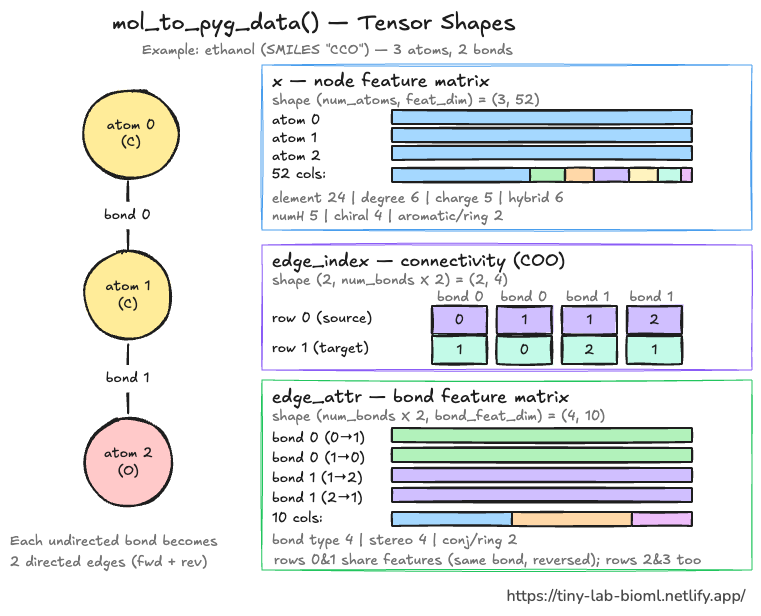
def atom_features(atom: Chem.rdchem.Atom) -> np.ndarray:
    """
    Returns a bit vector of atom features.
    atom: RDKit atom object (from Mol object)
    returns: 1D np.array of atom features with shape (52,)
    """
    return np.array(
        one_hot(atom.GetSymbol(), ATOM_LIST) +
        one_hot(atom.GetTotalDegree(), [0, 1, 2, 3, 4, 5]) +
        one_hot(atom.GetFormalCharge(), [-2, -1, 0, 1, 2]) +
        one_hot(atom.GetHybridization(), HYBRIDIZATIONS) +
        one_hot(atom.GetTotalNumHs(), [0, 1, 2, 3, 4]) +
        one_hot(atom.GetChiralTag(), CHIRAL_TAGS) +
        [int(atom.GetIsAromatic()), int(atom.IsInRing())],
        dtype=np.float32,
    )

def bond_features(bond: Chem.rdchem.Bond) -> np.ndarray:
    """
    Returns a bit vector of bond features.
    bond: RDKit bond object (from BondList object)
    returns: 1D np.array of bond features with shape (10,)
    """
    return np.array(
        one_hot(bond.GetBondType(), BOND_TYPES) +
        one_hot(bond.GetStereo(), STEREO_TYPES) +
        [int(bond.GetIsConjugated()), int(bond.IsInRing())],
        dtype=np.float32,
    )

def mol_to_pyg_data(smiles: str,
                    y: np.ndarray | None = None,
                    w: np.ndarray | None = None
                    ) -> Data | None:
    """
    Converts a SMILES string into a PyTorch Geometric Data object.

    Args:
      smiles: The SMILES string of the molecule.
      y: Optional target labels (e.g., toxicity values) for the molecule.
      w: Optional weights/mask for the target labels (1 for present, 0 for missing).

    Returns:
      A PyTorch Geometric Data object representing the molecule, or None if the SMILES
      string cannot be parsed or results in a molecule with no atoms.
    """
    mol = Chem.MolFromSmiles(smiles)
    if mol is None or mol.GetNumAtoms() == 0:
        return None
    x = torch.tensor(np.stack([atom_features(a) for a in mol.GetAtoms()]), dtype=torch.float)
    # x is node features of shape: (num_nodes_in_molecule, num_node_features)

    edge_index, edge_attr = [], []
    for bond in mol.GetBonds():
        i, j = bond.GetBeginAtomIdx(), bond.GetEndAtomIdx()
        bf = bond_features(bond)
        edge_index += [[i, j], [j, i]]
        edge_attr += [bf, bf]
    if len(edge_index) == 0:  # single-atom molecule edge case, no bonds (e.g. bare ions like [Na+])
        edge_index = torch.empty((2, 0), dtype=torch.long)
        # PyG expects shape (2, num_edges), so empty (2, 0) is start/end nodes with no edges
        # torch.long gives int64
        edge_attr = torch.empty((0, BOND_FEAT_DIM), dtype=torch.float)
        # Gives empty edge_attr shape (0, 10)
    else:
        edge_index = torch.tensor(edge_index, dtype=torch.long).t().contiguous()
        # If a atom has N bonds -> edge index will be: (2, 2 * N), which is:
        # (StartAtom/EndAtom, i:j/j:i * N bonds)
        edge_attr = torch.tensor(np.stack(edge_attr), dtype=torch.float)
        # edge_attr output: (2 * N bonds, 10)

        """
        Demo:
        edge_index = [[1, 2], [2, 1], [3, 4], [4, 3]]
        In [29]: torch.tensor(edge_index, dtype=torch.long)
        Out[29]:
        tensor([[1, 2],
                [2, 1],
                [3, 4],
                [4, 3]])
        In [30]: torch.tensor(edge_index, dtype=torch.long).t()
        Out[30]:
        tensor([[1, 2, 3, 4],
                [2, 1, 4, 3]])
        """

    # PyG Data object aggregates all the information for a single graph into one container
    data = Data(x=x, edge_index=edge_index, edge_attr=edge_attr, smiles=smiles)
    if y is not None:
        data.y = torch.tensor(y, dtype=torch.float).view(1, -1)
        data.mask = torch.tensor(w, dtype=torch.float).view(1, -1)
    return data

ATOM_FEAT_DIM = len(atom_features(Chem.MolFromSmiles("CCO").GetAtomWithIdx(0)))
BOND_FEAT_DIM = len(bond_features(Chem.MolFromSmiles("CCO").GetBondWithIdx(0)))
print("atom feature dim:", ATOM_FEAT_DIM, "| bond feature dim:", BOND_FEAT_DIM)
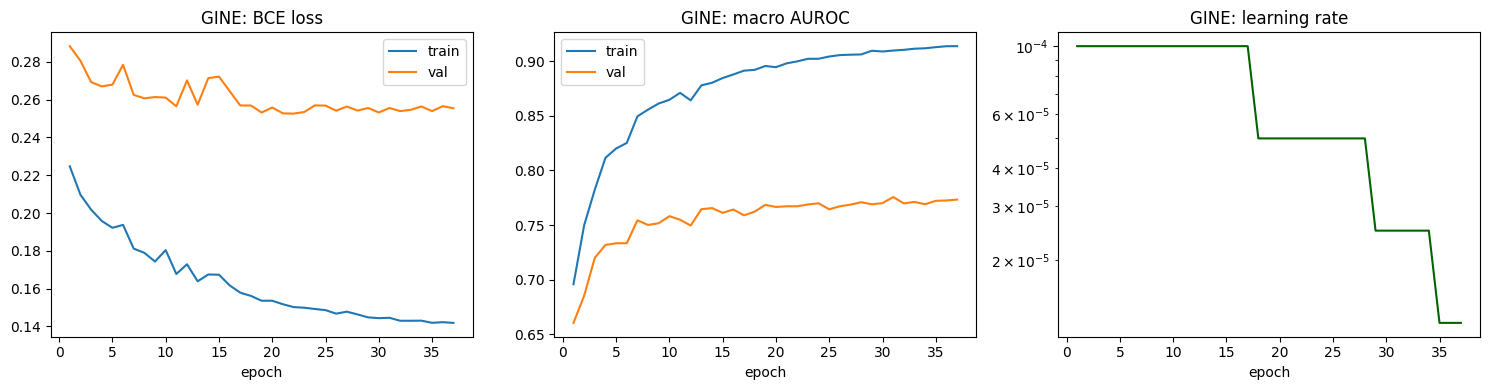
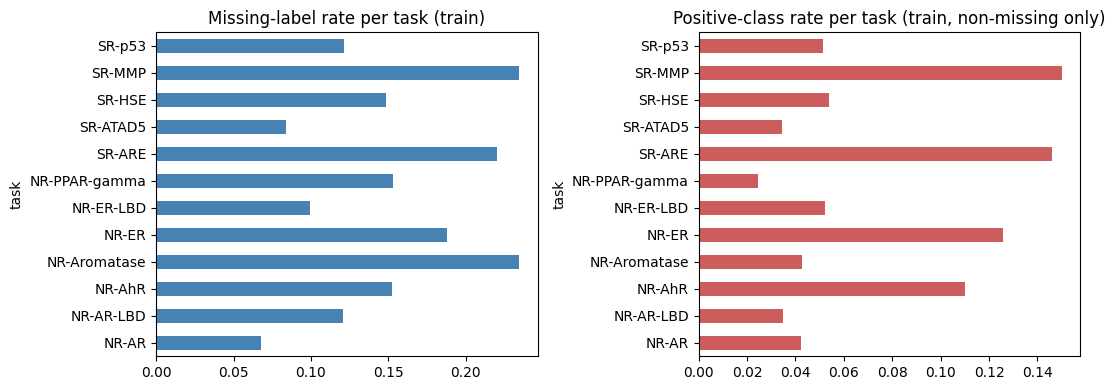 As we can see, the Tox21 dataset is highly imbalanced, with some tasks having very few positive examples. There are also many missing labels. We will deal with these problems by including metrics that are robust to class imbalance (AUPRC) and by using a loss function that ignores missing labels. To that end, both AUROC and AUPRC will be computed per task and then macro-averaged across tasks. The loss function will be a masked binary cross-entropy loss, which ignores missing labels during training.