Code
from get_chembl_bioactivity_data import fetch_chembl_targets, get_chembl_bioactivity_data
# Step 1: see what ChEMBL targets match this UniProt ID
targets_df = fetch_chembl_targets("P00533") # EGFR
print(targets_df)Small, reusable Python utilities for pulling target-specific bioactivity and compound data from ChEMBL given a UniProt ID, and evaluating those compounds against Lipinski’s rule of five — adapted from TeachOpenCADD T001: Compound data acquisition (ChEMBL) and T002: Molecular filtering (Ro5).
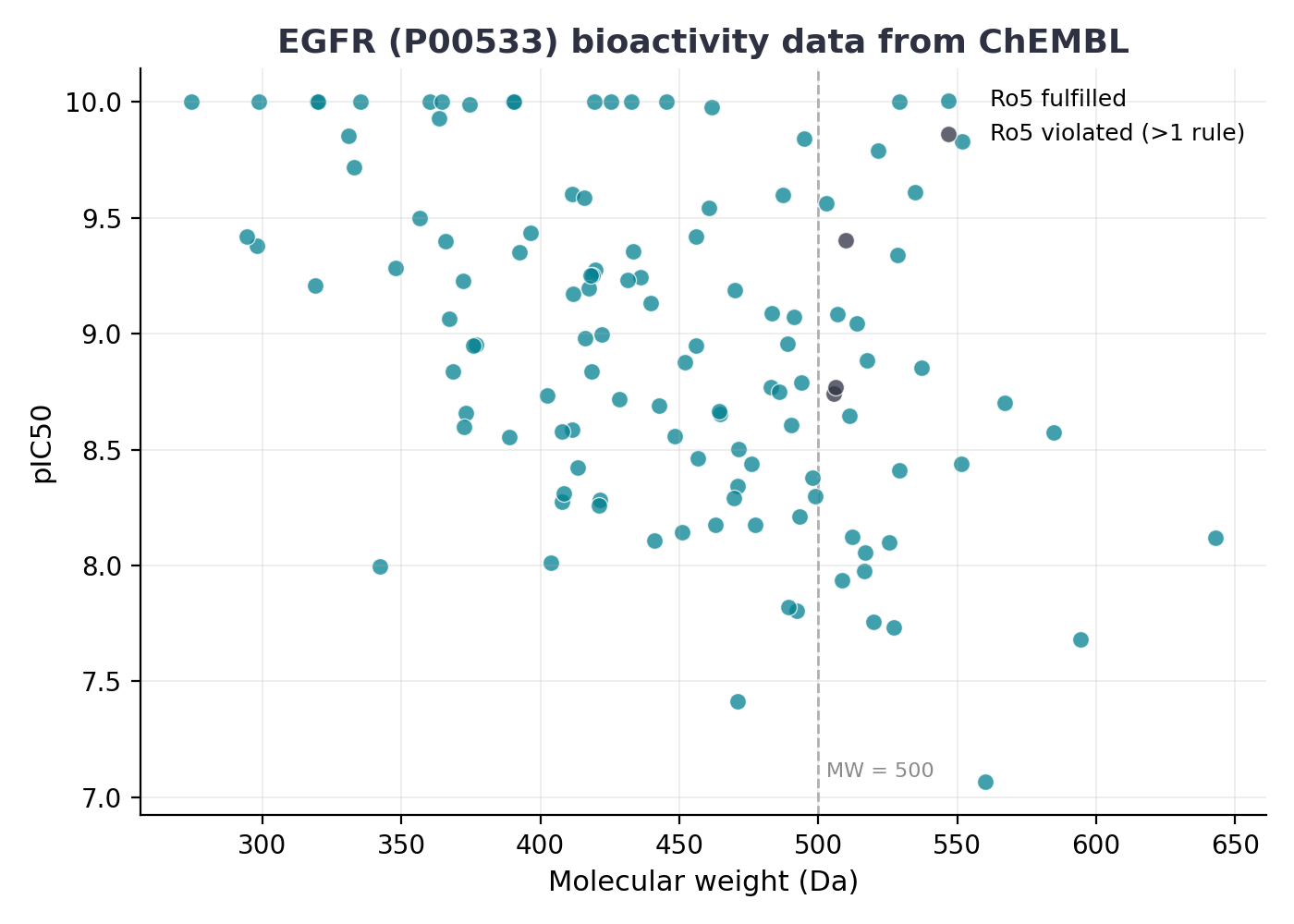
Given a UniProt accession (e.g. P00533 for EGFR), it:
… and returns a tidy pandas.DataFrame with columns:
| molecule_chembl_id | IC50 | units | smiles | pIC50 |
Adding Ro5 properties appends: molecular_weight, n_hba, n_hbd, logp, ro5_fulfilled.
git clone https://github.com/jaychung10010/chembl-target-query.git
cd chembl-target-query
pip install -r requirements.txtA UniProt accession can map to multiple ChEMBL target entries (single protein, protein family, chimeric construct, protein-protein interaction, etc.), so the workflow is split into two steps — inspect, then extract. This avoids blocking input() prompts, so it works in any environment (plain scripts, Jupyter, agent-driven IDEs like Antigravity/Cursor where stdin isn’t interactive).
from get_chembl_bioactivity_data import fetch_chembl_targets, get_chembl_bioactivity_data

# Step 1: see what ChEMBL targets match this UniProt ID
targets_df = fetch_chembl_targets("P00533")  # EGFR
print(targets_df)
Output:
Found 17 ChEMBL target(s) matching 'P00533':

        organism                                                                             pref_name target_chembl_id                  target_type
0   Homo sapiens                                                      Epidermal growth factor receptor        CHEMBL203               SINGLE PROTEIN
1   Homo sapiens                                                      Epidermal growth factor receptor        CHEMBL203               SINGLE PROTEIN
2   Homo sapiens                            Epidermal growth factor receptor and ErbB2 (HER1 and HER2)    CHEMBL2111431               PROTEIN FAMILY
3   Homo sapiens                                                      Epidermal growth factor receptor    CHEMBL2363049               PROTEIN FAMILY
4   Homo sapiens                            MER intracellular domain/EGFR extracellular domain chimera    CHEMBL3137284             CHIMERIC PROTEIN
5   Homo sapiens                                     Protein cereblon/Epidermal growth factor receptor    CHEMBL4523680  PROTEIN-PROTEIN INTERACTION
6   Homo sapiens                                                                           EGFR/PPP1CA    CHEMBL4523747  PROTEIN-PROTEIN INTERACTION
7   Homo sapiens           von Hippel-Lindau disease tumor suppressor/Epidermal growth factor receptor    CHEMBL4523998  PROTEIN-PROTEIN INTERACTION
8   Homo sapiens          Baculoviral IAP repeat-containing protein 2/Epidermal growth factor receptor    CHEMBL4802031  PROTEIN-PROTEIN INTERACTION
9   Homo sapiens                                                                             CCN2-EGFR    CHEMBL5465557  PROTEIN-PROTEIN INTERACTION
10  Homo sapiens  Microtubule-associated protein 1 light chain 3 beta/Epidermal growth factor receptor    CHEMBL6066839  PROTEIN-PROTEIN INTERACTION
11  Homo sapiens        Glucose-induced degradation protein 4 homolog/Epidermal growth factor receptor    CHEMBL6066845  PROTEIN-PROTEIN INTERACTION
12  Homo sapiens                     E3 ubiquitin-protein ligase Mdm2/Epidermal growth factor receptor    CHEMBL6193792  PROTEIN-PROTEIN INTERACTION
13  Homo sapiens                                                  UBR/Epidermal growth factor receptor    CHEMBL6193830  PROTEIN-PROTEIN INTERACTION
14  Homo sapiens       Protein zyg-11 homolog B/Protein zer-1 homolog/Epidermal growth factor receptor    CHEMBL6193837  PROTEIN-PROTEIN INTERACTION
15  Mus musculus                                     Protein cereblon/Epidermal growth factor receptor    CHEMBL6193841  PROTEIN-PROTEIN INTERACTION
16  Homo sapiens                   E3 ubiquitin-protein ligase RNF149/Epidermal growth factor receptor    CHEMBL6195769  PROTEIN-PROTEIN INTERACTION

Inspect the table above, then call get_chembl_bioactivity_data('P00533', target_index=<row>) with your chosen row index.# Step 2: extract bioactivity + compound data for the target you want
# (inspect targets_df above, then pick its row index)
df = get_chembl_bioactivity_data("P00533", target_index=0)
print(df.head())Output:
molecule_chembl_id   IC50 units  \
0        CHEMBL63786  0.003    nM
1        CHEMBL35820  0.006    nM
2        CHEMBL53711  0.006    nM
3        CHEMBL66031  0.008    nM
4      CHEMBL5270693  0.008    nM

                                              smiles      pIC50
0                  Brc1cccc(Nc2ncnc3cc4ccccc4cc23)c1  11.522879
1                CCOc1cc2ncnc(Nc3cccc(Br)c3)c2cc1OCC  11.221849
2                 CN(C)c1cc2c(Nc3cccc(Br)c3)ncnc2cn1  11.221849
3                Brc1cccc(Nc2ncnc3cc4[nH]cnc4cc23)c1  11.096910
4  COc1cc(N2CCC(N(C)C)CC2)ccc1Nc1ncc(C(=O)Oc2cccc...  11.096910
Adding Lipinski’s rule of five (Ro5) properties:
from get_chembl_bioactivity_data import add_ro5_properties

df = add_ro5_properties(df)
# adds: molecular_weight, n_hba, n_hbd, logp, ro5_fulfilled
print(df.head())
Output:
molecule_chembl_id   IC50 units  \
0        CHEMBL63786  0.003    nM
1        CHEMBL35820  0.006    nM
2        CHEMBL53711  0.006    nM
3        CHEMBL66031  0.008    nM
4      CHEMBL5270693  0.008    nM

                                              smiles      pIC50  \
0                  Brc1cccc(Nc2ncnc3cc4ccccc4cc23)c1  11.522879
1                CCOc1cc2ncnc(Nc3cccc(Br)c3)c2cc1OCC  11.221849
2                 CN(C)c1cc2c(Nc3cccc(Br)c3)ncnc2cn1  11.221849
3                Brc1cccc(Nc2ncnc3cc4[nH]cnc4cc23)c1  11.096910
4  COc1cc(N2CCC(N(C)C)CC2)ccc1Nc1ncc(C(=O)Oc2cccc...  11.096910

   molecular_weight  n_hba  n_hbd    logp  ro5_fulfilled
0        349.021459      3      1  5.2891           True
1        387.058239      5      1  4.9333           True
2        343.043258      5      1  3.5969           True
3        339.011957      4      2  4.0122           True
4        562.269239      8      2  6.1267          False
Skipping target_index falls back to auto-selecting the first SINGLE PROTEIN + Homo sapiens match (printing a warning if none exists) — useful for unattended/batch runs over many targets:
targets = ["P00533", "Q00534", "P07900"]  # example UniProt IDs
results = {uid: get_chembl_bioactivity_data(uid) for uid in targets}Queries and prints all ChEMBL targets matching a UniProt accession. Returns the DataFrame so you can inspect target_type, organism, and pref_name before choosing which row to extract.
Runs the full extraction pipeline for the selected target and returns the merged, filtered bioactivity + compound DataFrame with pIC50 values.
Converts an IC50 value in nM to pIC50 (9 - log10(IC50)).
Computes molecular weight, H-bond acceptor/donor counts, logP, and Lipinski’s rule of five compliance (ro5_fulfilled, True if no more than one of the four Ro5 conditions is violated) for a single SMILES string.
Applies calculate_ro5_properties to every row of a DataFrame (e.g. the output of get_chembl_bioactivity_data) and returns a copy with the Ro5 columns appended.
=), binding assays (B), nM units, first-seen compound kept on duplicates.Built on the chembl_webresource_client and adapted from the TeachOpenCADD platform (Volkamer Lab, Charité/FU Berlin).
MIT — see LICENSE.